
The slowdown in corporate revenue growth over the last one year has begun to reflect in India Inc's capital expenditure, or capex. The country's top listed companies are going slow on fresh investment in capacity expansion, in line with a deceleration in their top line growth. The combined fixed assets of the listed companies, excluding banking, finance services and insurance (BFSI) and the government-owned oil & gas firms, were up 10.1 per cent year-on-year (Y-o-Y) during April-September 2023 (H1FY24) - the slowest in 18 months - as against 21.1 per cent Y-o-Y growth in H2FY23 (October 2022-March 2023) and 11.6 per cent growth in the April-September 2022 period (H1FY23).

The Mumbai-based real estate developer Oberoi Realty has been one of the top-performing companies in its segment and most brokerage remains bullish on the stock. The company's stock price is 52 per cent in the last 12 months beating the broader market by a huge margin. The benchmark BSE Sensex is up just 6.5 per cent during the period.

Her reasoning is simple, "It's a Tata company. No shareholder will let go of this opportunity," she told Business Standard. When asked if the other reason for lining up for the IPO is the technology sector and the fact that the combination of Tata and tech is happening after almost two decades, she replied: "The name of the company and the group matter. Tata means stability and credibility," she added.
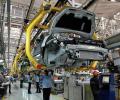
The K-shaped economic recovery in India from the pandemic slowdown shows in corporate results as well. The automobile sector, which represents big-ticket consumption, continues to do well and has increased its share in corporate revenues and profits while fast-moving consumer goods (FMCG) companies that sell low-ticket consumer goods are struggling with poor sales and earnings growth. The share of the automobile sector, including makers of auto ancillaries, in corporate net sales rose to a 10-quarter high of 10.05 per cent during July-September 2023 (Q2FY24) from 8.94 per cent a year earlier and 9.75 per cent in Q1FY24.

Corporate earnings got a big boost from the fall in commodity and energy prices in July-September 2023 (Q2FY24) despite a slowdown in revenue growth during the quarter. The combined net profits of 3,123 firms that have declared their results so far were up 38 per cent year-on-year (Y-o-Y) to Rs 3.07 trillion in Q2FY24, up from Rs 2.24 trillion a year ago. Earnings were, however, down 3.5 per cent on a sequential basis from Rs 3.18 trillion in April-June (Q1) FY24.

For Lori Beer, chief information officer, JPMorgan Chase & Co, largest banker in the US, India is a big part of the organisation's global technology footprint and is core to its products and services. This is evident from the fact that in less than two months since JPMorgan & Chase chief executive officer Jamie Dimon visited India, Beer has come here to see the recently opened centres in Mumbai and Bengaluru. "What is different for me this year are our new centres and to be able to come and see the vibrancy, and connectedness is great.

'Our Q1 was almost flat, and there was very negligible growth in Q2, but the deal pipeline and the order book have been fairly significant.'

'We will have a strong exit as our third quarter is strong.'

Even as the slowdown in the information technology (IT) services sector deepens, banking, financial services and insurance (BFSI), as well as oil and gas companies, emerge as the primary drivers of corporate earnings in the country. The IT services sector's share in corporate earnings declined to a five-year low of 17.4 per cent in the second quarter (Q2) of 2023-24 (FY24), whereas banks and finance companies accounted for 46.5 per cent, and oil and gas firms contributed 16.8 per cent. At their peak, IT services firms like Tata Consultancy Services (TCS), Infosys, HCLTech, and Wipro represented just over a third of the combined net profit of all listed companies in the Business Standard sample.

10 non-bank and non-finance stocks from the BSE500 Index universe that offer an optimal blend of low valuation, reasonably robust revenue and earnings growth in recent quarters, a strong balance sheet, and most importantly, positive cash flow from their operations.

The combined net profit of "early bird" companies, those that have declared their quarterly results, rose for the third consecutive quarter in July-September 2023 (Q2FY24). But the figures suggest a continued slowdown in revenue growth and stagnation in earnings over recent quarters. This slowdown is severe for companies in the manufacturing and non-financial service sectors.

'A cutback in hiring and compensation growth by IT companies will have a significant impact on consumer demand, especially in the urban sector of the economy.'

TCS saw its headcount reduced by 6,333. Infosys' headcount decreased by almost 7,500, and HCLTech saw its employee numbers shrink by 2,299.

'IT companies do not have a large presence there either in terms of market and team. So, the impact of the war will be minimal. But West Asia is an emerging economy.'

India's corporate sector is likely to report a slowdown in revenue growth and earnings for the July-September 2023 period (Q2FY24), according to earnings estimates by brokerages, after the country's top listed companies posted higher than expected profits for the first quarter. The combined net profit of Nifty50 companies, based on brokerage estimates, is expected to have grown by 19.6 per cent year-on-year (Y-o-Y) to Rs 1.75 trillion in Q2FY24 - a sharp deceleration from 37.6 per cent Y-o-Y growth in the combined earnings of index companies in the April-June 2023 period. According to estimates, the combined earnings in the second quarter would be down 8.8 per cent on a quarter-on-quarter (Q-o-Q) basis and the lowest in the past three quarters.

The reported buyback of Temasek's 20 per cent stake in Tata Play by Tata Sons will be the third instance of Tata Group providing an exit to a foreign partner in recent years. In 2018, Tata Sons paid $1.27 billion to DoCoMo to buy back 26 per cent of the group's telecommunication venture, Tata Teleservices. This was followed by Tata Sons acquiring AirAsia Berhad's 49 per cent stake in AirAsia India in two tranches to make it a wholly owned subsidiary.

WhatsApp's advantage is that it is the first app millions of Indian check first thing in the morning and innumerable times during the day and night.

Metal and mining companies, such as Tata Steel, JSW Steel, Hindalco, and Coal India, have been among the top-performing sectors on the bourses in recent months. The S&P BSE Metal Index is up 13 per cent in the past three months, rallying 29 per cent in the past year, outperforming the broader market. For comparison, the benchmark S&P BSE Sensex has only seen a 1.7 per cent increase in the past three months, with a 15 per cent gain since the end of September last year.

However, the second quarter of FY24 is expected to be muted, and, with that, the hope of double-digit growth is now being pushed to FY25. However, analysts are expecting the momentum in the closure of record total contract values (TCVs) will continue, as has been the case over the last two quarters.

The recent surge in crude oil prices could shave off the gains made by India Inc in profit margins in the past few quarters. Worse, it comes at a time when consumer demand in the country is slipping and major global economies are witnessing a slowdown. A back-of-the-envelope calculation suggests that the margin expansion accounted for three-fourths of the rise in the listed firms' operating profit between the April-June quarter (Q1) of FY23 and Q1FY24, and only a quarter of profits gains came from revenue growth.
 © 2026 Rediff.com - Advertise with us - Disclaimer - Privacy Policy - Sitemap - Feedback - About us - Terms of use - Grievances